


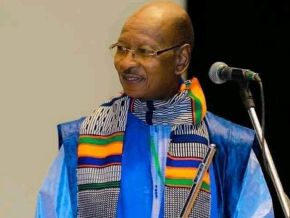
From Gao to Havana and from Abidjan to Paris, the maestro used his music to build a cultural bridge between Africa and Havana’s Malecón, a major gathering place for cultural events in Cuba. By blending the sounds of the Sahel with the syncopated pulse of Cuban clave, he gave Africa and the world a landmark musical legacy.
Boncana Maïga, the Malian musician known across Africa as “the maestro,” died at 77 in a Bamako clinic at 5 a.m. on Feb. 28, 2026. News of his death, announced on Malian television and social media, drew tributes from Senegal, Benin, France, Cuba and beyond, reflecting the reach of an artist whose music had shaped generations.
His legacy extended beyond his recordings. Over more than half a century, he built a musical bridge between the Niger River and Havana, connecting the Manding rhythmic tradition with Cuban syncopation. Millions of African listeners experienced that connection, often without realizing it. In the countries where he was mourned, his music still draws people to dance floors and keeps alive memories of Africando’s remarkable history.
Determined to Become a Musician
“My mother never wanted me to go into music,” he told Mali Web in 2007. Yet music entered his life early and remained part of it for decades.
Born in Gao in either 1948 or 1949, Boncana Issa Tandagari Maïga grew up in the northern Malian city, whose history was shaped by caravan trade, former empires and griot traditions.
He belonged to the Songhai people, whose culture places great value on both speech and silence. Words are not to be wasted, while silence can convey restraint and dignity. It was in this environment that Maïga fell in love with music at an early age.
Born in Gao in either 1948 or 1949, Boncana Issa Tandagari Maïga grew up in the northern Malian city, whose history was shaped by caravan trade, former empires and griot traditions.
Those who knew him then remembered a boy with an insatiable curiosity and an ear capable of breaking down a rhythm after hearing it only once on the radio. Resourceful and self-taught, he learned to play the saxophone. Much to his parents’ dismay, he formed his first group, the Négro-Band, in 1959 or 1960, when he was barely a teenager.
He toured Mali with the orchestra and learned his craft on stage, performing for audiences who might dance one night and remain unmoved the next. That experience, gained on stage rather than in a classroom, shaped the musical instincts of the man who would later become the maestro. Before long, he could sense when a melody needed to open up, when the bass should enter and when silence should be allowed to settle.
Havana: 10 Years Learning the Clave
In 1963, Modibo Keïta, the first president of a newly independent Mali, was pursuing an unusual form of cultural diplomacy. A committed socialist and friend of Fidel Castro, he selected 10 young Malian musicians and sent them to study in Cuba at Havana’s Alejandro García Caturla Conservatory. Keïta saw music as more than entertainment. It was a means of asserting national sovereignty and giving the new Mali a presence on the world stage.
Maïga was among those selected. He was barely 15 and had no classical training. His parents were also less than enthusiastic. “I was happy, but my parents did not feel the same way because I was the family’s only son,” he said. “In the end, everything worked out. I went to Cuba and stayed for 10 years.”
He arrived on the Caribbean island in January 1964 and did not leave until 1973. Havana in the 1960s was alive with revolutionary fervor. Music pulsed through every courtyard, while charanga orchestras competed nightly in the cabarets along the Malecón. For the 10 young Malians arriving from another continent, it was a complete immersion in clave, the fundamental rhythmic pattern underlying Afro-Cuban music, as well as in son montuno, bolero, danzón and cha-cha-chá.
Their command of the charanga style, built around flutes and violins, astonished even Cuban musicians. The Malians played the style more convincingly than some local performers.
Some found the experience too difficult and returned home. Three left before completing the program. The seven who remained became deeply rooted in Havana’s musical life.
Barely a year after their arrival, in 1965, Maïga, who had by then become an arranger, flutist and de facto orchestra leader, guided his fellow musicians through the recording of their first album. Named after the group, “Las Maravillas de Mali,” or “The Wonders of Mali,” the record displayed remarkable youthful confidence and daring. It featured male vocals, flutes, violins, piano and percussion, with songs in Spanish, French and Malian languages. Bolero appeared alongside son montuno, while guaracha incorporated Sahelian rhythms.
Their command of the charanga style, built around flutes and violins, astonished even Cuban musicians. The Malians played the style more convincingly than some local performers.
“Chez Fatimata,” a cha-cha-chá combining a Wolof first name with an impeccably Havana-style arrangement, became a hit in nightclubs across the continent. Che Guevara was even said to have danced to one of their songs. Through their music, African and Cuban traditions came together again.
A Dream Cut Short
The dream could not last. While the seven Malians were enjoying success in Havana, politics in Mali changed dramatically.
On Nov. 19, 1968, a group of officers led by Moussa Traoré overthrew Modibo Keïta. The president who had sent them to Cuba and treated music as a matter of state was removed from power. The Maravillas did not yet realize how fundamentally their position had changed.
When they finally returned home in 1973, Mali was no longer the country they had left. The young socialist republic had given way to a military regime with little interest in an Afro-Cuban orchestra created as the centerpiece of a cultural diplomacy that no longer existed. The group tried to survive, recruited new musicians and searched for a place in the new order. It found none. The Maravillas de Mali received no place in official cultural programming.
When they finally returned home in 1973, Mali was no longer the country they had left. The young socialist republic had given way to a military regime with little interest in an Afro-Cuban orchestra created as the centerpiece of a cultural diplomacy that no longer existed.
The group broke up. It was one of post-independence Africa’s great missed opportunities: an exceptional orchestra trained at considerable expense and then dissolved for lack of public support. Maïga refused to allow the group’s collapse to end his own career. He chose to leave. “I left Mali through the window, and Côte d’Ivoire opened its doors wide to me,” he said in an interview years later, with no apparent bitterness.
Abidjan, Where the Arranger Came Into His Own
Félix Houphouët-Boigny’s Côte d’Ivoire was then a land of opportunity. The country invested in culture, promoted its artists and welcomed talent from across Africa. Maïga moved there in 1973 and found a thriving cultural environment.
He became a music teacher at the National Arts Institute and later deputy director of the conservatory. More importantly, he took charge of the Radiodiffusion Télévision Ivoirienne orchestra, which he led for 14 years. The position brought him financial security and prestige. “I was paid more than a Malian minister in Côte d’Ivoire,” he said, recalling how he had been able to buy a house and had been named a Knight of Côte d’Ivoire’s National Order.
He later summed up his relationship with his adopted country in one sentence: “Côte d’Ivoire gave me everything, and I gave everything to Côte d’Ivoire.”
Maïga made an equally significant contribution to Ivorian and West African music. At Abidjan’s JBZ studios, he became West Africa’s most sought-after arranger, working with an entire generation of musicians.
He discovered Aïcha Koné, who spent four years as a backing singer with the RTI orchestra before he produced her first song. He wrote brass and string arrangements for Nahawa Doumbia, Amy Koïta, Kandia Kouyaté, Oumou Sangaré, Abdoulaye Diabaté and Kassé Mady Diabaté.
Maïga made an equally significant contribution to Ivorian and West African music. At Abidjan’s JBZ studios, he became West Africa’s most sought-after arranger, working with an entire generation of musicians.
He arranged Alpha Blondy’s first five albums and collaborated with Manu Dibango when the Cameroonian musician visited Abidjan. The film industry also turned to him. He composed the music for the television film “Aya” in 1986 and Henri Duparc’s celebrated “Bal Poussière” in 1988. In 1980, the Fania All Stars, a leading force in New York salsa, him to join its African tour. Maïga’s international profile had never been higher. Musicians across Africa wanted his touch.
Africando and the Return of Clave
The end of the 1980s brought a decline in the popularity of Afro-Cuban music. Funk and soul, followed by zouglou and mapouka, took over the airwaves, and African salsa increasingly came to be viewed as a thing of the past.
Maïga moved to Paris in 1984, opening a new phase in his career. He reunited with Alpha Blondy for the album “Masada” and met Senegalese producer Ibrahima Sylla, who shared his concern about the decline of Afro-Cuban music. Sylla headed the Syllart label and had helped launch the careers of artists including Salif Keïta and Baaba Maal.
Their first collaboration, Nahawa Doumbia’s 1988 album “Djina Mousso,” laid the foundation for a close working relationship. Sylla liked to tell the story. “After the album was finished and mixed, Boncana Maïga brought me the tape and returned the money he had not spent,” he said. “He is a trustworthy and talented man.”
That trust led in the early 1990s to one of African music’s most remarkable projects. Its name made its purpose clear: Africa andando, or Africa on the move.
Sylla’s idea was both simple and audacious. He wanted to bring together the leading voices of West African salsa and have them record with the best Latin musicians. Maïga insisted on New York rather than Paris because of his deep understanding of clave.
Africando became for Africa what the Fania All Stars had been for Latin America: a dream team. Maïga shaped the arrangements throughout. Three decades after Havana, the flutist from Gao had forgotten nothing.
The group brought together Senegalese singers Pape Seck of Dakar’s Star Band, Medoune Diallo of Orchestra Baobab and Nicolas Menheim of Super Étoile. They were later joined by Benin’s Gnonnas Pedro, Burkina Faso’s Amadou Balaké and Guinea’s Sékouba Bambino.
The result exceeded all expectations. From its earliest recordings in the 1990s through “Viva Africando” in 2013, the collective released a series of successful albums and filled dance floors from Abidjan to New York and from Dakar to Paris.
Africando became for Africa what the Fania All Stars had been for Latin America: a dream team. Maïga shaped the arrangements throughout. Three decades after Havana, the flutist from Gao had forgotten nothing.
In 1997, Maïga received the Kora Award for best arranger, an honor that recognized his work behind the performers. He was no longer regarded simply as an orchestra leader. In the African music industry of the time, he became known as a mentor to singers and a driving force behind their careers. He notably helped Gnonnas Pedro become an international star.
Maïga Returns to Mali and Becomes a Teacher
The man who said he had “left Mali through the window” returned through the front door in the mid-2000s, when President Amadou Toumani Touré invited him back to stage a major performance for a France-Africa summit.
Maïga returned, and this time Malians were determined that he would stay. “My relatives grabbed me by the shirt and told me I had already spent 50 years abroad,” he recalled.
In 2005, he settled permanently in Bamako. He founded Maestro-Sound Mali, a production company that became a training ground for young talent. He also hosted “Stars Parade,” a music program broadcast on TV5 Monde that aired its 1,000th episode in December 2018. Beginning in 2009, he co-hosted “Tounkagouna,” a program devoted entirely to discovering new voices. The maestro had become a link between generations. He passed on the discipline he had learned at the Havana conservatory to younger musicians who did not always know the origins of the salsa they danced to.
At the center of the story was Maïga, the last surviving leader of the orchestra. He agreed to revisit painful memories and bring the group together to perform again. The camera followed him to Havana for an emotional reunion with Cuban musicians 45 years after the album was recorded.
Over the years, he became a living archive of African music history spanning the 1980s and later decades. In 2020, he participated in the making of “Africa Mia,” a documentary by Richard Minier and Édouard Salier that was the result of 18 years of painstaking research.
The film revived the forgotten story of the Maravillas de Mali. Its filmmakers tracked down the surviving members, who had grown old and scattered. The project became a race against time as the former members died one after another.
At the center of the story was Maïga, the last surviving leader of the orchestra. He agreed to revisit painful memories and bring the group together to perform again. The camera followed him to Havana for an emotional reunion with Cuban musicians 45 years after the album was recorded.
A new lineup returned to the road, Universal reissued the record and the group’s story came full circle. Maïga’s emotion on screen was unmistakable. “When I watched the documentary, I saw the story of my early years up to 1973, the year I left Cuba,” he said, his voice choked with emotion, in an interview. “I had never imagined that anyone could retrace the lives of the Maravillas de Mali and Boncana Maïga.”
The Music Lives On
On Feb. 28, 2026, at Bamako’s Clinique Pasteur, Maïga died after a long illness. He was the last surviving member of the Maravillas de Mali. His death closed the final chapter in the orchestra’s story and ended a distinctive form of musical exchange between continents. Tributes poured in from Abidjan, Dakar, Cotonou and Conakry. Malian Culture Minister Mamou Daffé said Maïga’s death represented a loss not only for Mali, but also for African culture, which he had helped promote across continents.
In Abidjan, singer Aïcha Koné mourned him as a father rather than merely a mentor. “He was like a father who comforted me,” she said. “He would pat me on the back and give me confidence. He took me on as a backing singer and trained me for four years before launching my career with my first song, which he arranged himself.”
An Officer and Knight of Mali’s National Order and a Knight of Côte d’Ivoire’s Order of Merit, Maïga left behind a body of work that millions of dancers will keep alive, often without knowing his name. He will also be remembered as the boy from Gao who taught himself the saxophone, crossed three continents over half a century and connected the musical traditions of the Niger River and Havana. He devoted nearly his entire life to his art. “My ambition is to support Malian music and the arts more broadly,” he said when asked what kept him going despite his advanced age.
Several months after his death, the maestro’s work continues to resonate.
Servan Ahougnon